Hitting a Deer in Pennsylvania and Maryland: Coverage, Claims and Prevention
Key Takeaways
-
Hitting a deer is covered under the comprehensive part of your auto policy, not collision. If you carry liability only, damage to your own vehicle isn't covered.
-
If you swerve, miss the deer and hit something else, that's usually a collision claim instead. Different coverage, different deductible.
-
In Pennsylvania, a wildlife accident is treated as a not-at-fault incident and the state limits when an insurer can surcharge that kind of claim. Maryland has no equivalent rule.
-
Deer hits peak in October, November and December, especially around dawn and between 6 p.m. and 9 p.m.
-
The best time to check your coverage is before an accident can happen, not after.
Deer crashes can happen any time of year, but there are far more deer near roads during mating season in October, November and December. If you drive rural roads in central Pennsylvania or western Maryland, you already know the feeling of catching a shape in the headlights and hoping it stays put.
What most drivers don't know is how their policy will respond if a deer accident occurs — and that's the part worth sorting out now, while you're reading this, instead of while standing on a road shoulder at dusk.
Does Insurance Cover Hitting a Deer?
Yes, if you carry comprehensive coverage. Hitting a deer falls under the comprehensive part of your auto policy rather than collision. You pay your comprehensive deductible, and your policy covers the repair costs above it, up to your vehicle's actual cash value.
If you carry liability only, damage to your own vehicle isn't covered. Liability pays for damage you cause to other people and their property, and a deer doesn't file a claim.
Comprehensive is optional coverage, which is exactly why this catches people out. Plenty of drivers assume "full coverage" includes it. Full coverage isn't an actual coverage type, though. It usually means liability, comprehensive and collision together, but the only way to know what you carry is to check your declarations page or ask your agent.
Comprehensive or Collision: Which One Pays?
It comes down to what you hit.
Comprehensive covers damage from things outside your control: animals, falling branches, hail, fire, theft and vandalism. Collision covers damage from hitting another vehicle or an object like a guardrail, a pole or a tree.
So if you hit the deer, or it hits you, that's generally comprehensive. Swerve, miss it and end up in a ditch, and that's collision. It's worth knowing which deductible applies before you're working it out at the side of the road.
It's important to note that there are instances in which a deer accident could instead qualify under your collision coverage instead of comprehensive. If you run over or hit a deer that is already dead on the roadway, insurers can vary whether this is classified as a comprehensive or collision accident. The best way to ensure your insurance has you protected from any deer-related accident is by holding both comprehensive and collision coverage.
What Happens If You Swerve to Avoid a Deer?
This is where it gets counterintuitive. If you swerve, miss the deer and hit a tree, guardrail or another vehicle, that's normally handled as a collision claim rather than a comprehensive one.
So the deer you successfully avoided can cost you more than the one you hit, because you're now looking at a different deductible and a crash that may well be treated as at fault.
It's also the more dangerous outcome. Braking firmly and staying in your lane is what safety agencies advise, and it's the advice that holds up whether you're thinking about your bumper or your insurance.
Will a Deer Claim Raise Your Rates?
That depends which state you're in, and the two states we write in don't necessarily treat it the same way.
In Pennsylvania, guidance from the Pennsylvania Insurance Department describes a crash involving a deer or other wildlife as a not-at-fault incident, and Pennsylvania limits when an insurer can apply a surcharge to that kind of claim.
In Maryland, there's no equivalent rule. A 2024 study by the Maryland Insurance Administration found that a minority of private passenger auto insurers in the state do apply a surcharge after a wildlife accident. Legislation to prohibit it was proposed but didn't pass.
Either way, your own policy terms and your claims history govern what actually happens. After you've filed a claim, your claim adjuster can review the accident details and advise you how your coverage will apply. Additionally, your independent agent can tell you where your coverage stands before you ever need to file, which can be a better time to find out.
What to Do Right After You Hit a Deer
-
Check for injuries and get somewhere safe. Turn on your hazard lights and move onto the shoulder if the vehicle is still drivable.
-
Stay away from the deer. An injured deer is frightened and strong, and it can hurt you badly.
-
Call the police if the law requires it. In Pennsylvania you're required to notify police if anyone is injured or killed, or if the damage means you can't drive the vehicle from the scene. Even when you aren't required to call, a report gives your claim a clear record.
-
Photograph everything. The road, your surroundings, the damage to your vehicle and any injuries. If anyone stopped, ask for their contact details.
-
Report a deceased deer on a state road. Pennsylvania drivers can call 1-800-FIX-ROAD.
-
Report the claim. Do it within 24 to 48 hours if you can. Waiting makes damage harder to tie to the accident. Your agent can walk you through what to expect and what your comprehensive deductible will be.
When Are Deer Accidents Most Likely in Pennsylvania?
The answer is overwhelmingly autumn. An industry claims study covering July 2024 through June 2025 found that October, November and December accounted for 41 percent of animal collision claims nationally. That same study found Pennsylvania had more animal hit claims than any other state, at roughly 147,000.
PennDOT recorded 6,426 deer-related crashes in Pennsylvania in 2024, a five-year high. That figure counts only crashes reportable to the state, meaning an injury or a vehicle towed from the scene, so the real number of minor deer accidents is considerably higher.
The risk concentrates at dawn and between 6 p.m. and 9 p.m., when deer are moving and drivers can see least.
How to Avoid a Deer Accident
Use the following tips to help avoid a vehicle-deer crash:
-
Drive at a safe speed. Driving more slowly gives you more time to react if an animal steps out.
-
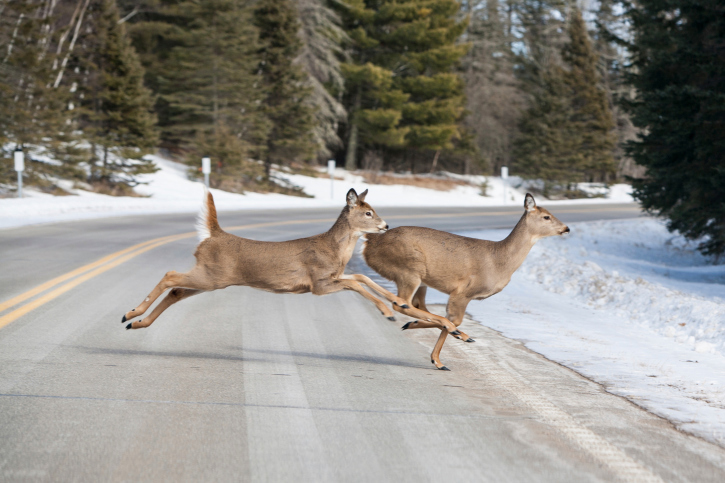
Expect a second deer. Deer travel in herds; as the adage goes, “It’s always the deer you don’t see.” If one animal crosses the road, a second or third is often right behind it.
-
Brake firmly and stay in your lane. Swerving is what turns a comprehensive claim into a collision with a tree, a guardrail or an oncoming car, and those crashes tend to be far more dangerous than hitting the deer.
-
Use extra caution at dawn and dusk. This is when deer are most active and driver visibility is poorest.
-
Don't rely on deterrents. Deer whistles, repellent devices and fences haven't proven effective at keeping deer off the road.
-
Watch the shoulders. Look for the reflection of deer eyes and for silhouettes at the edge of your headlights.
-
Take deer crossing signs seriously. They mark places where deer are known to cross regularly. These signs aren't simply general warnings.
-
Wear your seat belt. It's the simplest protection if an accident does happen, and the Pennsylvania Insurance Department lists it among its deer season recommendations.
Frequently Asked Questions
Do I need a police report if I hit a deer?
In Pennsylvania you're only required to call police if someone is injured or killed, or if the vehicle is too damaged to drive away. Outside those situations it's optional, but a report gives your claim a clear record and we'd suggest it.
How long do I have to report hitting a deer to my insurer?
As soon as you reasonably can, ideally within 24 to 48 hours. Waiting makes damage harder to tie to the collision, and policies set their own filing windows. However, see your policy decs for specific requirements.
Is it illegal to hit a deer and drive away in Pennsylvania?
No. You aren't penalized for the hit itself, and you don't have to report it to the Pennsylvania Game Commission. You do, however, have to stop and notify police if there's an injury or death, or if the damage leaves your vehicle undrivable.
Does hitting a deer count as an at-fault accident?
In Pennsylvania, guidance from the state Insurance Department describes it as a not-at-fault incident. Maryland doesn't have an equivalent rule, so how it's treated there depends on the insurer. Your policy terms govern either way, and your agent can confirm your situation.
What if the deer runs off and there's no proof?
You don't need the animal to file a comprehensive claim. Photographs of the damage and the scene, and a police report if you have one, are what matter. Hair or hide on the bumper helps but isn't required.
Check Your Coverage Before the Rut
Deer season is predictable in a way most driving risks aren't. You know when it's coming, you know which hours are worst, and you know which coverage decides whether a collision costs you a deductible or a few thousand dollars.
Before the rut peaks in November, it's worth a few minutes to confirm comprehensive is on your auto policy and that your deductible is set where you want it. Your independent agent in Pennsylvania or Maryland can pull up your declarations page while you're on the phone and tell you exactly what you'd be covered for.